
Audit Overview
Your store's untapped revenue potential — and how to unlock it
Why We Created This Audit
We analyzed gharsoaps.shop the same way we've audited 350+ e-commerce stores — looking for the specific gaps between your current experience and what top-performing Beauty stores deliver. Every finding in this report is a revenue opportunity backed by industry data and competitive benchmarks.
What We Analyzed
- UX & Conversion Design10 findings
- Technology & App StackPlatform + 6 apps
- Industry BenchmarksBeauty
Pages Analyzed
- Homepage2 findings
- Collection Pages3 findings
- Product Pages (PDP)3 findings
- Cart & Checkout2 findings
 This audit was prepared by Growisto — a CRO-led Website development team behind 167% conversion growth for Atomberg, 46% CR lift for TyresNmore, and 350+ e-commerce projects.
UX & Conversion Findings
Page-by-page analysis with visual comparisons against top Beauty stores
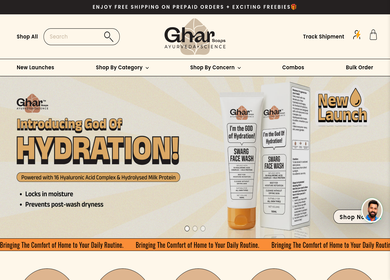
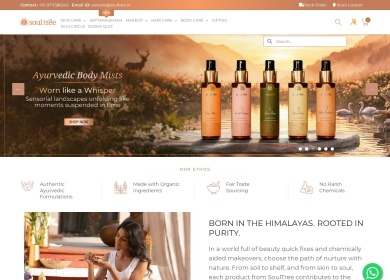
- Ghar Soaps has Klaviyo installed (detected in page source) — the email marketing infrastructure is in place — but there is no first-visit popup, exit-intent overlay, or scroll-trigger to capture email addresses from new visitors.
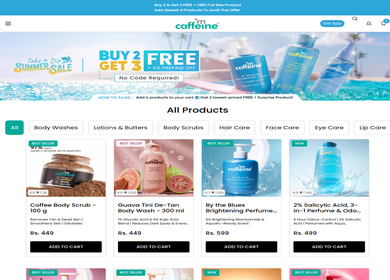
- 9 of 10 beauty benchmark stores use a first-visit popup. Mamaearth shows a 'Get 10% off your first order' modal within 5 seconds of landing; mCaffeine uses a 'Join the Club' popup with a discount code. Both are among India's highest-converting beauty D2C brands.
- Email flows (welcome series, abandoned cart, post-purchase) typically drive 15–25% of Beauty D2C revenue. Without a list-building popup, Ghar Soaps is missing the primary mechanism to feed those flows — the email program becomes increasingly expensive to run as the list ages without new additions.
- Ghar Soaps' mobile app download banner offers 10% off on first purchase — this incentive should be replicated as a web popup for non-app users, who represent the majority of traffic.
- Activate a Klaviyo first-visit popup (already available in the installed app) with a 10% off code for first purchase — consistent with the app download offer. Trigger it after 5 seconds on desktop and 10 seconds on mobile, or on exit-intent for desktop.
- Keep the popup single-field (email only, not name + email) — each additional field reduces submission rate by 20–30%. A clean 'Enter email → Get 10% off' is sufficient to capture intent.
- Run a 30-day A/B test: Version A = percentage discount (10% off), Version B = free gift with first order (consistent with Ghar Soaps' existing freebie cart mechanic). The freebie offer may convert better for a brand whose identity is built around gifting extras.
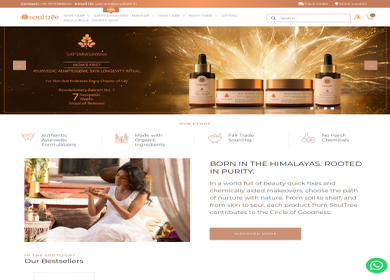
- Ghar Soaps' mobile experience uses a hamburger-menu top navigation — users must reach to the top corner to access categories, a significant UX friction point on larger smartphones that dominates India's D2C traffic.
- 4 of 5 India D2C beauty stores in our benchmark (Mamaearth, mCaffeine, Plum, Minimalist) use a persistent 5-icon bottom navigation bar — Home, Shop, Search, Wishlist, Account. This has become the India mobile-first standard for beauty brands.
- mCaffeine's implementation includes 'Shop by Concerns' and 'Shop by Ingredient' as primary navigation paths — bringing the brand's skin-science identity directly to the mobile navigation without requiring a hamburger menu interaction.
- Ghar Soaps already has multiple navigation categories (Soaps, Face, Body, Shop By Concern) — a bottom nav consolidates the most-used paths (Home, Shop, Search, Cart) into thumb reach at all times, particularly valuable during skincare browsing where shoppers compare multiple products.
- Implement a 5-icon sticky bottom navigation bar for mobile (max-width: 768px): Home, Shop, Search, Wishlist (once added), Account. Keep icons labelled with single-word captions for accessibility.
- Link the Shop icon to the best-sellers collection rather than a generic 'all products' page — first-time visitors are most likely to purchase from the brand's highest-converting collection.
- For Ghar Soaps' skin-concern positioning (de-tan, dark spots, acne), consider a 'Concerns' icon in the bottom nav that opens a slide-up concern selector — this reinforces the brand's problem-solution positioning at the navigation level.
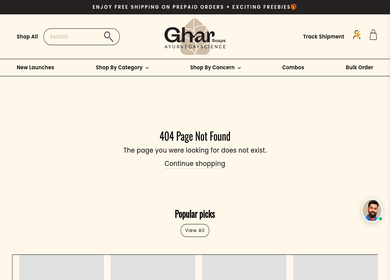
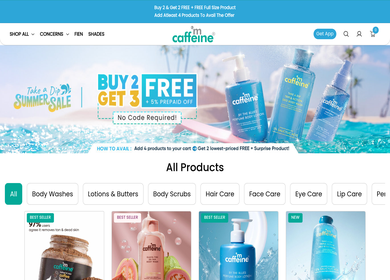
- Ghar Soaps' collection page offers only a sort dropdown (Featured, Best Selling, Price) for a catalog of 40+ SKUs across soaps, face washes, serums, sunscreen, and body care — no filtering by skin concern, ingredient, product type, or skin type.
- 9 of 10 beauty benchmark stores offer multi-attribute filtering. mCaffeine uses both 'Shop by Concern' (exfoliation, dryness, acne, pigmentation) and 'Shop by Ingredient' (Coffee, Niacinamide, Vitamin C) as primary navigation paths — matching how beauty shoppers actually browse.
- Ghar Soaps organises its navigation by concern (Tanning solutions, Dark Spots & Pigmentation, Acne, Exfoliation Kits) — this structure exists in the main nav but is not replicated as filters within the collection page. A shopper looking for acne products must navigate to a specific collection rather than filter from the main catalog.
- For a brand whose core positioning is 'Ayurveda + Science' with specific active ingredients (Kojic Acid, Salicylic Acid, Vitamin C, Ceramides), ingredient-based filtering directly serves the growing segment of skincare-educated shoppers who buy by ingredient.
- Add faceted filtering to the main collection page with at minimum: Skin Concern (De-tan, Dark Spots, Acne, Exfoliation, Hydration), Product Type (Soap, Face Wash, Serum, Sunscreen, Body Wash), Key Ingredient (Kojic Acid, Vitamin C, Salicylic Acid, Ceramides, Charcoal). These 3 filter dimensions cover 90% of skincare shopping intent.
- Install SearchPie or a similar Shopify faceted filter app — these take 2–3 hours to configure and do not require theme code changes. They plug directly into Shopify's collection structure.
- Add 'Bestseller' and 'New' toggle badges as quick-filter pills above the product grid — these are the two highest-engagement sort interactions for first-time beauty shoppers and require no new app install.
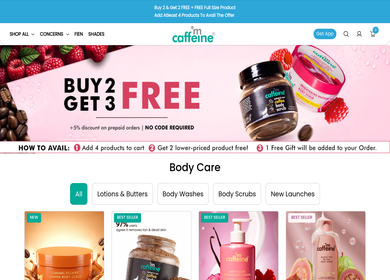
- Ghar Soaps product cards show image, title, price, and discount — no heart icon, bookmark, or save-for-later button is present. Beauty shoppers frequently browse routine combinations across multiple sessions before purchasing.
- 7 of 10 beauty benchmark stores have wishlist functionality. mCaffeine shows a heart icon on every product card and tracks saved items in the navigation header — making wishlist a first-class browsing action rather than a buried feature.
- Skincare is a considered purchase category — shoppers often research 3–5 products before adding one to cart. Without a wishlist, they rely on browser history or screenshots to return to a specific product. A wishlist reduces this friction and increases the likelihood of a return-visit purchase.
- Ghar Soaps' cart freebie mechanic ('You are 2 products away from 1st freebie') already motivates multi-product consideration — a wishlist enables customers to curate their 3-product shortlist before activating the freebie threshold, making both mechanics work together.
- Add a heart/bookmark icon on every product card (top-right overlay) and on every PDP beside the ATC button. The icon should toggle between empty (not saved) and filled (saved), with a login/account prompt for first-time users.
- Display wishlist count in the header navigation (next to the cart icon) for logged-in users. A count of '3 saved items' creates a return-visit incentive — especially effective after a first abandoned session.
- Integrate wishlist with Klaviyo (already installed) to send a 'You left something behind' email 24–48 hours after a user adds items to wishlist without purchasing. Klaviyo's wishlist abandonment flow is a native feature requiring no additional app.
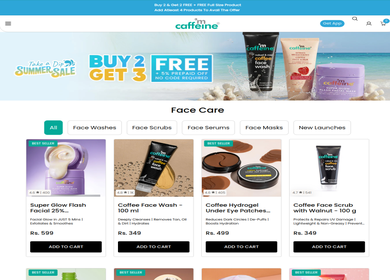
- Ghar Soaps collection cards use heavy urgency language: 'Only 57 Left!!!', '10L+ Sold Out!!', 'Hurry! Limited Stock' — but do not show a star rating or review count beside the product name. The social proof is absent at the browse stage.
- The star rating (4.8–4.9) and large sold-out counts that Ghar Soaps uses as copy-level claims are not surfaced as structured data on collection cards — they appear as marketing text rather than verified review scores, which reduces credibility for sceptical first-time buyers.
- Mamaearth shows '★ 4.8 / 153 Reviews' directly on every collection card — this structured format is more trusted by shoppers than copy-level claims because it references a verifiable count. Judge.me (already installed by Ghar Soaps) supports collection card rating widgets natively.
- Beauty shoppers in India are increasingly ingredient-savvy and review-dependent — a Statista 2025 study found that 74% of Indian skincare shoppers check reviews before first purchase. Burying this data below the fold on PDPs misses the browse-stage decision point.
- Enable the Judge.me collection card rating snippet — it is a toggle in the Judge.me app dashboard, requiring no theme code change. Show the aggregate star score and review count beneath the product name on every card.
- Replace or complement the 'Only X Left!!!' tags with a more trust-building format: '★ 4.9 · 2,400 reviews' paired with a 'Bestseller' badge is more persuasive for first-time buyers than artificial scarcity signals.
- Retain one urgency indicator per card (e.g., low stock for genuinely limited SKUs) but balance it with a social proof count — the combination of '★ 4.9 · 1,200 reviews + Only 20 Left' is more effective than urgency alone.
- Ghar Soaps' mobile PDP places the Add-to-Cart button above the fold below the product gallery — once a shopper scrolls down to read the key benefits, ingredients, how-to-use, and review section, the ATC button is no longer visible without scrolling back up.
- 8 of 10 beauty benchmark stores implement a sticky ATC bar on mobile. Mamaearth's bar shows product name, size, price, and an 'Add to Cart' CTA at the bottom of the screen at all times — it's present throughout the entire product page scroll.
- Ghar Soaps PDPs have substantial content to scroll through — benefits section, Ayurveda + Science callout, key ingredients, how-to-use, reviews — making the scroll distance from the native ATC to the bottom of the page significant on most mobile devices.
- India's beauty D2C traffic is 75–80% mobile (SimilarWeb benchmarks for comparable brands). A missing sticky ATC represents an ongoing conversion gap across the vast majority of Ghar Soaps sessions.
- Implement a sticky bottom bar on mobile (triggered after scrolling 300px past the native ATC) containing: product image thumbnail, product name (truncated), pack size, price, and an 'Add to Cart' button in Ghar Soaps' brand colour.
- For products with multiple pack options (1-piece, 2-piece, combo), the sticky bar should show the currently selected variant — not always default to the smallest pack. This preserves the selection the shopper made above the fold.
- Test a sticky bar that shows the freebie progress alongside the ATC: 'Add to cart — you'll be 1 product away from a freebie' — this combines the purchase CTA with the existing gamification mechanic that already drives cart behaviour.
- Ghar Soaps' combo packs and bundles are priced between ₹399 and ₹1,499 — the ₹599–₹999 combo range is exactly where BNPL messaging drives meaningful conversion lift for considered purchases among value-conscious India D2C buyers.
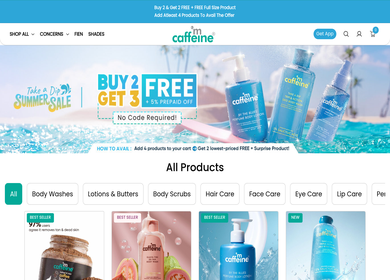
- 6 of 10 beauty benchmark stores display BNPL or EMI messaging on the PDP. mCaffeine integrates Simpl for 3-EMI checkout; Plum shows 'No Cost EMI available' below the price for orders above ₹499. Both are India-native BNPL providers with Shopify apps.
- Ghar Soaps' positioning targets everyday skincare (de-tan soaps, face washes) — these are repeat purchases where a first-time combo order at ₹699 can be a barrier. BNPL removes the 'too much for a first try' hesitation and allows the brand to upsell combos without price objections.
- Simpl and Snapmint both offer Shopify apps that surface 'Pay in 3 parts' messaging directly below the price on the PDP without requiring checkout modifications — each is a 1–2 hour install.
- Install Simpl or Snapmint (both Shopify-native) to display 'Pay in 3 parts with Simpl — No Cost EMI' beneath the product price for all orders above ₹499. Show the per-installment amount: 'Or pay ₹233/month × 3'.
- For the cart page, add a 'No-Cost EMI on orders above ₹499' trust note below the cart total — this reinforces the option at the checkout-intent moment where BNPL conversion is highest.
- Prioritise BNPL messaging on Ghar Soaps' combo pages (Magic Soap + Face Wash bundles, Skincare Routine kits) — these higher-value orders are where the ₹X/month framing most reduces the perceived price barrier.
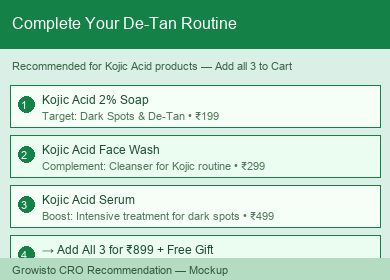
- Ghar Soaps PDPs do not include a cross-sell or 'frequently bought together' section — a shopper viewing the Kojic Acid Soap has no prompted path to discover the Kojic Acid Face Wash, Kojic Acid Serum, or Kojic Acid Serum that form a complete de-tan routine.
- 7 of 10 beauty benchmark stores implement routine-based or complementary-product cross-sell on PDPs. Forest Essentials' 'Complete Your Ritual' section groups products by skin concern — a shopper on a face oil PDP is shown a toner, serum, and moisturiser from the same concern family.
- Ghar Soaps' product catalog is specifically designed around skin concerns with matching active ingredients across categories (Kojic Acid Soap, Kojic Acid Face Wash, Kojic Acid Serum — all targeting dark spots and de-tan). This 'complete the routine' story is built into the catalog but never surfaced on PDPs.
- The cart page already shows 'Similar Products' — but cart cross-sell is lower-intent than PDP cross-sell. A shopper discovering the Kojic Acid routine on the product page (pre-ATC) will add to cart more readily than being cross-sold in the cart (post-ATC, post-decision).
- Add a 'Complete Your De-Tan Routine' section on Kojic Acid product PDPs showing the Soap, Face Wash, and Serum as a grouped bundle with a single 'Add All 3 to Cart' button. This surfaces the routine story directly on the product page.
- For each skin concern category, curate a 3–4 product routine bundle: De-Tan Routine (Kojic Acid Soap + Face Wash + Serum), Acne Routine (Salicylic Acid products), Hydration Routine (Ceramide products). These map exactly to Ghar Soaps' existing collection structure.
- Use a ReConvert or Rebuy Shopify app to automate 'frequently bought together' logic based on actual purchase data — this surfaces the highest-converting product combinations without manual curation and improves over time.
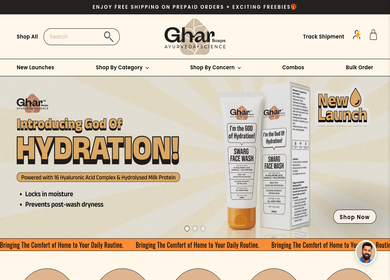
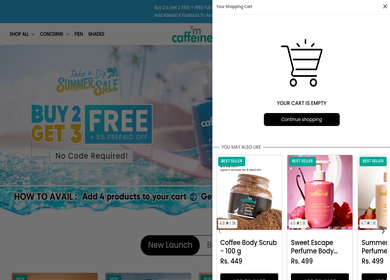
- Ghar Soaps shows the freebie mechanic on the homepage ('You are 2 products away from 1st freebie') and in the cart overlay text, but the cart page itself lacks a visual progress bar that dynamically updates as items are added or removed.
- 6 of 10 benchmark beauty stores display a progress bar in the cart — mCaffeine shows 'Add ₹X more to get a free gift' with a fill bar that updates in real-time as the cart total changes. This visual incentive reduces cart abandonment for shoppers who are close to the threshold.
- The freebie mechanic is Ghar Soaps' strongest differentiator (mentioned prominently on homepage and in product listings) — but it is not leveraged at the highest-intent moment (cart checkout) where it could prevent the 'I'll come back later' abandonment.
- For a shopper with 2 items in cart who is 1 product away from a freebie, showing '1 more product to unlock your free gift — choose from these 3 options' directly in the cart can increase both conversion rate and AOV simultaneously.
- Implement a visual freebie progress bar at the top of the cart drawer: 'Add 1 more product to unlock your free gift 🎁' with a fill bar showing progress toward the threshold. This is available as a Shopify cart drawer modification or via a Gift with Purchase app.
- Below the progress bar, show 2–3 'qualifying product' recommendations priced at ₹99–₹299 (low-cost add-ons) that push the cart over the freebie threshold — similar to how free shipping progress bars work, but with freebie-unlock as the incentive.
- When the cart reaches the freebie threshold, replace the progress bar with a green success state: '🎉 You've unlocked a free gift! Select your freebie:' with a product picker — this turns the cart into an interactive gifting experience rather than a passive checkout page.
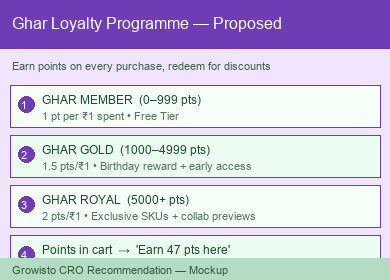
- Ghar Soaps has no formal loyalty or rewards programme — no points system, no membership tier, no birthday reward, no referral programme. The existing freebie counter in the cart is a gamification mechanic but not a structured retention programme.
- 4 of 10 benchmark beauty stores have loyalty programmes. mCaffeine's 'Caffeine Club' gives points on purchases, redeemable against future orders. Kama Ayurveda uses a tiered cashback structure. Both India beauty brands see 30%+ of revenue from returning customers.
- Ghar Soaps' customer base is ideal for loyalty: daily-use soaps and skincare are replenished every 30–60 days. A customer who buys once and returns 6× per year has significantly higher LTV than one who buys once. A loyalty programme creates the behavioural incentive to return to Ghar Soaps rather than trying a competitor on the next replenishment.
- The existing freebie mechanic demonstrates that Ghar Soaps customers respond to gamification incentives — this appetite, already evidenced in the cart behaviour, is the exact psychological hook that a loyalty programme amplifies.
- Launch a tier-based loyalty programme: GHAR MEMBER (0–999 pts, 1pt/₹1), GHAR GOLD (1000–4999 pts, 1.5pt/₹1 + birthday gift), GHAR ROYAL (5000+ pts, 2pt/₹1 + early access + exclusive SKUs). Points should be redeemable as ₹1 per 10 points.
- Integrate with Smile.io or LoyaltyLion (both Shopify-native) — these connect to Judge.me (already installed), enabling points for reviews as well as purchases. A 5-star review earns 100 points — creating a direct incentive to review that compounds the social proof asset.
- Surface loyalty points in the cart ('You'll earn 47 points on this order — worth ₹4.70 on your next purchase') and in the post-purchase email — the post-purchase 'points earned' message has the highest open rate of any loyalty touchpoint.
App Ecosystem
What's installed vs what's missing from best-in-class Beauty stores
Present (6)
Missing (6)
App Stack Assessment
Ghar Soaps has a solid operational foundation — Gorgias for support, Klaviyo for email, Tidio for chat, and ClickPost for post-purchase tracking. The gap is in the conversion and retention layer. Klaviyo is installed but underutilised: there is no first-visit popup to grow the email list, which is the highest-leverage use of the platform. The three highest-priority gaps are email capture popup (Klaviyo can do this natively, no new app needed), wishlist (prevents the 'I'll come back later and forget' drop-off), and BNPL (removes the price-hesitation barrier for ₹499+ combo orders). The existing freebie counter in the cart is a positive signal — users are engaged with gamification — making a full loyalty programme a natural next step once the top-of-funnel gaps are closed.
Confidential — Prepared for Ghar Soaps by Growisto | June 2026